

Looking berry good in November
Berries and fruits provide cheerful splashes of colour in the garden once leaves begin to fall.
Some of the shrub roses are terrific, laden with large red or orange hips, like ‘Fru Dagmar Hastrup’, ‘Scabrossa’ and ‘Scarlet Fire’.
Hips
Some of the rose species like Rosa rugosa, dog rose (R.canina), sweet briar (R.eglanteria) and R. moyesii also bear many hips, though they do form big vigorous bushes which are best sited in a large border or a semi-wild garden. They can also be planted as an informal hedge.
Male & female
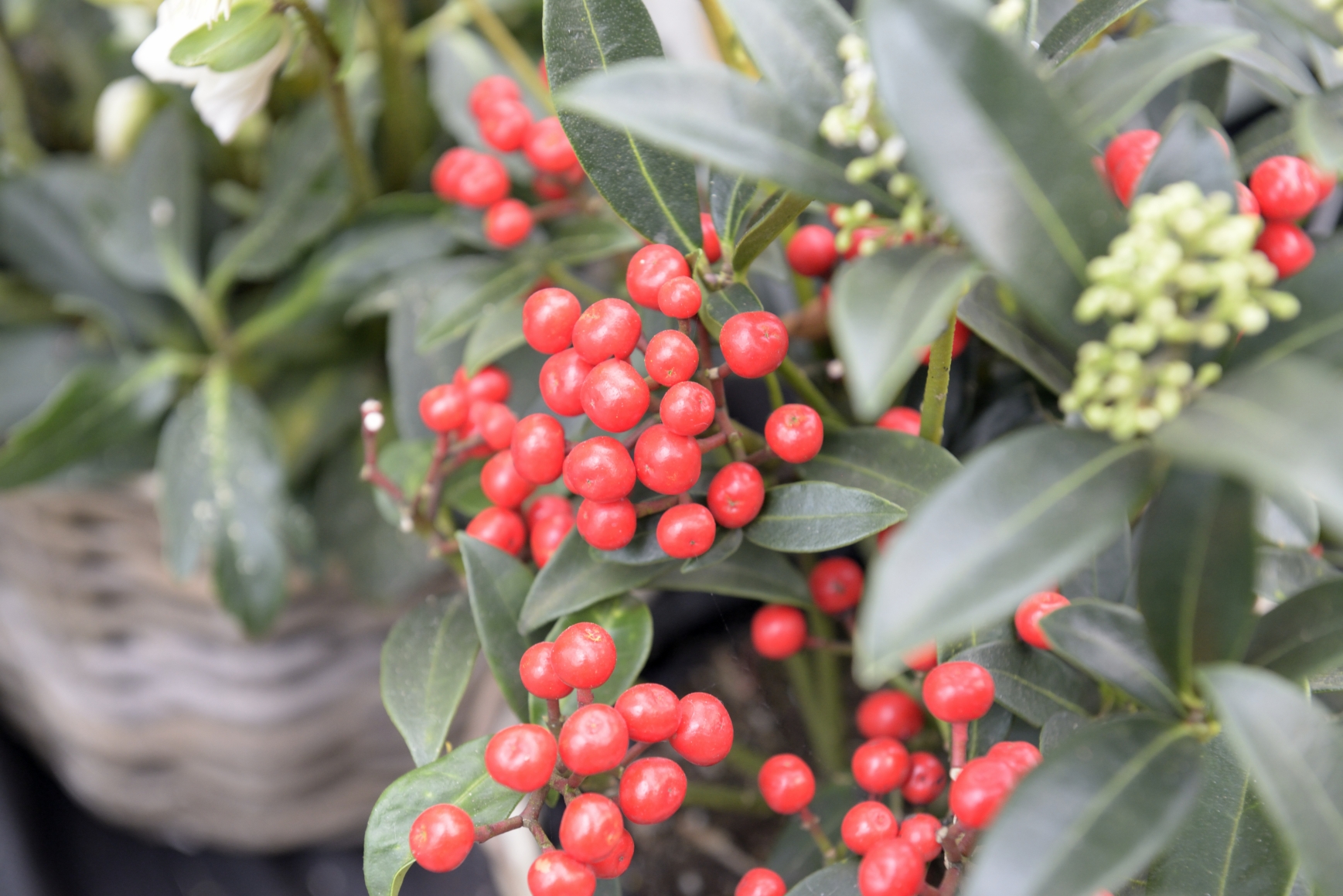
Several small berry-bearing shrubs require a male and female plant to produce berries. Skmmias form rounded domes of glossy evergreen foliage, and they bear bright red, long-lasting berries.
S.japonica reevesiana is particularly useful because it produces male and female flowers on the same plant, so one plant will do. It holds its deep sealing-wax-red berries right through winter.
Berries
Skimmias need a neutral or acid soil, as do Pernettya mucronata varieties which have white, ruby-red, pale or dark pink berries. Viburnum dividii has striking, bright turquoise-blue, egg-shaped berries, you’d need several bushes to get adequate pollination.
The gladwyn iris is a gem of a plant to cheer up a shady corner. It forms a neat clump of spiky evergreen leaves, and in autumn the swollen seed heads burst open to reveal masses of bright orange berries.
Don’t be put off by its other common name of ‘stinking iris’. When the leaves are crushed, they have a pleasant smell of roast beef!
Unusual berries
Shrubs with unusual berries include Callicarpa bodinieri ‘Profusion’ with masses of small, deep lilac-pink berries. Clerodendrum trichotomum has bright blue ones which are maroon at the base.
Flowering nutmeg (Leycesteria formosa) bears dangling clusters of claret-red berries. They’re popular with pheasants, hence its other name of pheasant berry.